

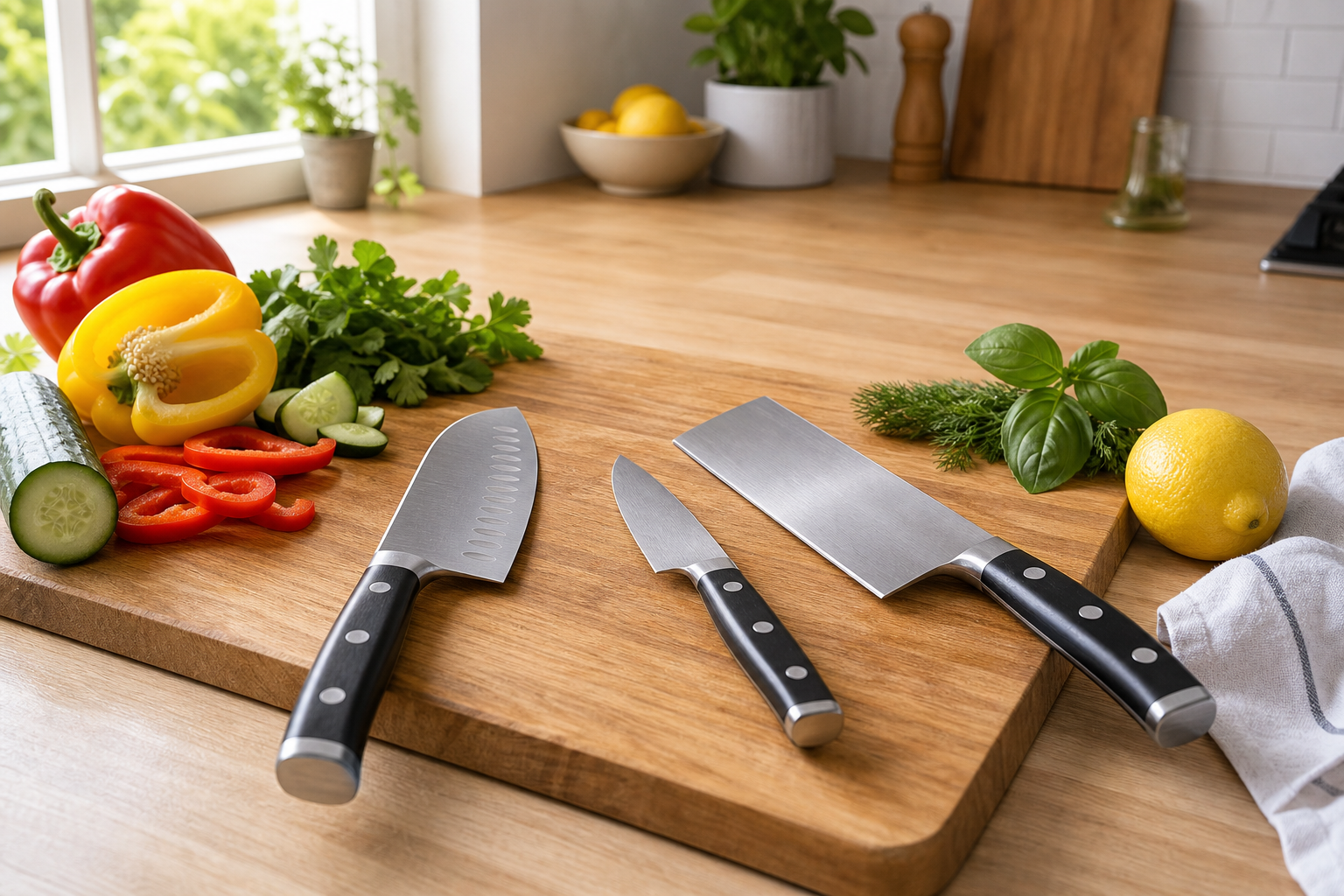
The short answer: choose a santoku when you want one compact all-purpose knife for vegetables, boneless meat and herbs; choose a utility knife for smaller board work and detailed everyday cuts; choose a nakiri-style knife when vegetables are the main event and you prefer a broad, straight-edged blade. The right choice depends less on the knife's name than on your most frequent ingredients, cutting motion, hand fit and available board space.
This guide compares the three shapes without treating any one of them as universally best. It uses current Chuakoo product specifications for examples and links to official food-safety guidance for the care practices that apply in any home kitchen.
Santoku vs utility vs nakiri at a glance
| Knife style | Best starting use | Typical strength | Consider before choosing |
|---|---|---|---|
| Santoku | Mixed everyday prep | Compact, versatile blade for slicing, dicing and mincing | Shorter length may require more passes on large ingredients |
| Utility | Small fruit, vegetables, sandwiches and trimming | More reach than a paring knife without the bulk of a chef's knife | Too small for efficient work on large produce |
| Nakiri-style | Vegetable-heavy prep | Broad blade and long edge contact for repeated chopping | Not a bone cleaver; use only for tasks allowed by the product instructions |
What is a santoku knife best for?
A santoku is a multipurpose kitchen knife with a relatively broad blade and a compact feel. It suits cooks who move between onions, herbs, fruit and boneless proteins in the same meal. Many people use a forward-and-down slice or a controlled chopping motion rather than the pronounced rocking action associated with a more curved Western chef's knife.
The live 5-inch stainless steel santoku knife is a useful store example because its product page identifies a five-inch blade, stainless steel construction and a resin handle. That shorter format can be convenient on a modest board or for cooks who find a longer knife unwieldy. Check the current page for availability and specifications rather than assuming every santoku shares those dimensions.
A santoku is not automatically the best option for splitting hard squash, cutting through bone or opening frozen food. Those jobs can damage a fine edge and create an unsafe slip. Match the blade to the task instead of using one knife for everything.
When does a utility knife make more sense?
A utility knife fills the space between a small paring knife and a full-size chef's knife. It is handy for halving citrus, slicing a sandwich, trimming strawberries, portioning cheese or making controlled cuts on medium-size produce. If your prep tasks are often too large for in-hand paring but too small to justify a broad blade, utility size can feel efficient.
Chuakoo's Japanese Damascus VG10 utility knife is listed with a five-inch blade, a 2 mm blade thickness and a G10 handle. Those are model-specific details, not universal utility-knife standards. Review the product's live measurements and images, then compare them with the handle and blade you already use comfortably.
A narrow utility blade is nimble, but its limited height may give less knuckle clearance on a cutting board. Test your grip and keep fingertips curled away from the edge. For large cabbage, watermelon or high-volume chopping, a larger board knife will usually be more practical.
Why vegetable-focused cooks consider a nakiri-style knife
A nakiri-style knife has a broad, mostly rectangular profile designed around vegetable preparation. Its long edge can make clean contact with the board across much of a cut, which works well for repeated slices through carrots, greens, cabbage and herbs. The broad side can also help move chopped vegetables, but use the spine or a bench scraper rather than dragging the sharp edge sideways across the board.
The store's 7-inch nakiri-style knife is described with a 67-layer Damascus-steel blade and an octagonal wooden handle. Although the listing also uses the word “cleaver,” a nakiri-shaped vegetable knife should not be assumed suitable for bones or frozen food. Follow the exact care and use information supplied with the product.
Use this four-step decision test
- List your five most common prep tasks. A knife should solve the work you do every week, not an imagined restaurant menu.
- Measure your board. A long blade on a cramped board can be awkward; a short blade may be inefficient on large produce.
- Compare handle comfort. Look at shape, material and transition from handle to blade. Comfort is personal, so product photos and measurements matter.
- Plan for maintenance. Every knife eventually needs appropriate honing or sharpening. A neglected premium blade is less useful than a maintained everyday one.
Sharpness, sharpening and edge care
A sharp knife still requires careful technique, but it generally needs less forcing than a dull edge. If a tomato skin crushes before the edge begins to slice, or an onion cut repeatedly skids, maintenance may be due. The correct angle and method depend on the blade, so consult the knife's own instructions before sharpening.
For shoppers building a maintenance kit, Chuakoo also carries a diamond knife sharpening stone. Its listing gives a size of approximately 15 × 6.2 × 2.5 cm. Confirm that the abrasive and intended technique are compatible with your knife; sharpening too aggressively can remove unnecessary metal.
Store knives dry and separated from loose utensils. A block, sheath or suitable magnetic holder can protect the edge while reducing accidental contact. Do not leave a knife hidden in soapy sink water where someone may reach into it.
Food-safe cleaning matters as much as blade choice
Wash the knife after each ingredient and dry it promptly, following the product's material-specific instructions. The U.S. Food and Drug Administration's home food-safety guidance recommends washing knives, cutting boards and counters with hot, soapy water after working with each food item. The Government of Canada advises using a different cutting board for raw meat, poultry or fish to help prevent cross-contamination.
The USDA cutting-board guide also says worn boards with hard-to-clean grooves should be replaced. A well-chosen knife cannot compensate for a damaged, unstable or contaminated work surface.
Frequently asked questions
Can a santoku replace a chef's knife?
For many home cooks, yes: a santoku can cover most daily slicing, dicing and mincing. A longer chef's knife may still be more efficient for large ingredients or cooks who prefer a rocking motion.
Is a utility knife the same as a paring knife?
No. A utility knife is usually longer and intended for board work, while a paring knife is compact enough for peeling and detailed in-hand tasks. Exact dimensions vary by model.
Can I use a nakiri knife to cut meat?
It can handle some boneless ingredients if the product instructions allow it, but its main strength is vegetable preparation. Do not treat a thin nakiri edge as a bone cleaver.
Should kitchen knives go in the dishwasher?
Follow the manufacturer's instructions. Hand washing and prompt drying are often gentler on sharp edges and handle materials. Never rely on a general category claim when the product's materials require specific care.
Which knife should a beginner buy first?
A compact santoku is a practical first choice for mixed everyday prep. Choose a utility knife if most jobs are small, or a nakiri-style knife if vegetable chopping dominates. Fit, control and maintenance matter more than the label.
The practical takeaway
Pick the knife that matches your real prep pattern. A santoku offers compact versatility, a utility knife handles smaller controlled cuts, and a nakiri-style blade favours repeated vegetable work. Compare current dimensions and materials, use a stable cutting board, keep the edge maintained and follow official food-safety habits. That combination will improve daily prep more than collecting blade shapes you rarely use.